

Hull state and movement regimes
A vessel in DRW is always in one of four movement regimes. The regime affects drag behaviour, lift behaviour, and how the camera reads the boat’s motion. This page connects the four regimes to the data-asset knobs that gate them.
The current regime is reported by EDRW_VesselMovementState and broadcast through the OnMovementStateChanged delegate: bind it for audio cues, FX swaps, or HUD readouts.
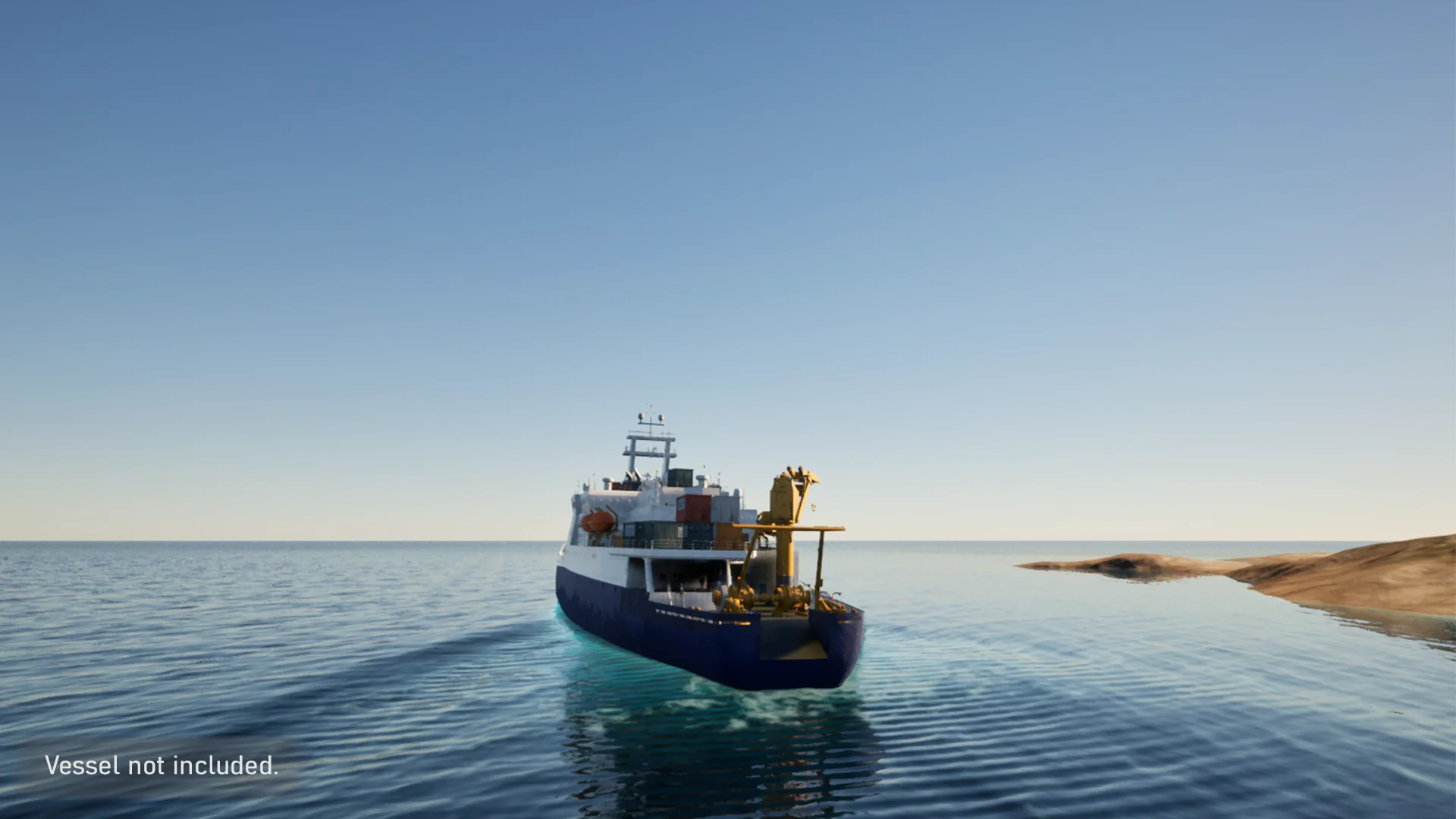
The vessel shown in this image is based on the Fab product called Research Ship.
Displacement
Section titled “Displacement”The default regime. The hull’s full submerged volume is supporting the vessel: buoyancy = weight, no dynamic lift contribution.
Behaviour: slow, efficient. Speed is bounded by hull speed (≈ 0.4 × Froude). Pushing harder makes a bow wave but doesn’t go faster.
Tuning knobs:
HullDataAsset.HullType = Displacement- Form coefficients (Block / Midship / Prismatic / Waterplane) shape resistance.
Use for: tugs, tall ships, large displacement craft, dinghies that never go fast.
Transition
Section titled “Transition”A short-lived regime between Displacement and Planing. The bow lifts, drag spikes momentarily, the boat is “fighting to climb on top of its bow wave.”
Behaviour: unstable feel, audible engine load, fast-rising bow. This is the dramatic moment in a powerboat acceleration.
Tuning knobs:
- Implicit: entered automatically when speed approaches
PlaningThresholdSpeedfrom below. - Tune
Stability.PitchDampingif the bow rises too sharply.
Planing
Section titled “Planing”The hull is partially out of the water, supported by dynamic lift. Drag drops dramatically; speed climbs.
Behaviour: fast, fuel-hungry, flatter ride. The boat is skimming.
Tuning knobs:
HydrodynamicsDataAsset.bEnablePlaning = truePlaningThresholdSpeed: speed at which lift onset begins.PlaningLiftCoefficient: how much lift the hull generates.PlaningWettedAreaRatio: wetted area at full plane (smaller = less drag, more speed).
Use for: runabouts, RIBs, modern sportboats, jet skis. The shipped BP_Runabout is configured for this regime.
Foiling
Section titled “Foiling”Hydrofoils have lifted the hull entirely out of the water. Only the foils touch.
Behaviour: very fast, very low drag, very narrow stability margin.
Tuning knobs:
- A
ControlSurfaceDataAssetwithType = Hydrofoilin the vessel’sControlSurfaces. FoilTakeoffSpeed: speed at which the hull rises.TargetFlyingHeight: height above water when fully foiling.FoilLiftCurve: optional, for fine-tuning lift vs angle of attack.
Use for: AC75-style yachts, foiling moths, futuristic high-speed craft.
How regimes connect
Section titled “How regimes connect”In a planing-capable hull, the typical sequence as throttle climbs:
- Displacement at idle and low speed.
- Transition as you approach
PlaningThresholdSpeed. - Planing above that speed.
For a foiling hull, add:
- Foiling above
FoilTakeoffSpeed.
Drop throttle and the sequence reverses. Each transition fires OnMovementStateChanged once.