
Approximating a Hull with Physics Shapes
The accuracy of buoyancy depends on how well your collision shapes approximate the underwater volume of the hull. This is the highest-skill workflow in the plugin and the most common source of “my boat doesn’t float right” issues.
Concepts
Section titled “Concepts”- Buoyancy is calculated per shape, not from the visible mesh. The plugin samples wave heights against your
Box/Sphere/Capsuleshapes onPhysicsBodyComponent: the rendered hull mesh is never sampled. Effective mass = sum of (additive shape volume × density) − (subtractive shape volume × density). - Material type sets density. Wood = 800 kg/m³, Steel = 7850, HighDensityFoam = 450, Air = 1.225. Water is 1025 kg/m³, so anything denser sinks unless balanced by Subtractive air pockets.
- Subtractive shapes carve out volume for cabin interiors, hollows, and air pockets. A shape with
MaterialType = Airis automatically marked Subtractive.
Workflow
Section titled “Workflow”-
Decide on overall mass. Pick a target weight from a real-world equivalent: small dinghies 50–150 kg, runabouts 300–1500 kg, sailing yachts 500 kg+. Mass results from your shape volumes × material densities; iterate by adjusting volumes or materials.
-
Approximate the submerged hull with 1–8 shapes. More shapes = better force distribution but more CPU per buoyancy step. Rules of thumb:
- Test object: 1 box.
- Dinghy / PWC: 1–3 boxes.
- Runabout / mid-size powerboat: 3–5 boxes (narrow box at bow, wider midship box, flat box at stern).
- Sailing yacht: 5–7 shapes (hull + keel as a separate dense ballast shape).
- Tall ship: 6–10 shapes (hull split forward / midship / aft, plus mast / rigging if you want their mass to influence stability).
-
Place shapes in the editor. Add them to
PhysicsBodyComponent → Boxes / Spheres / Capsules. Each shape’sTransformis local to theTargetComponent(typically the hull mesh). SetTargetComponentNameto your hull mesh’s component name. -
Pick the MaterialType per shape. This sets density. If you want a specific density not listed, set
MaterialType = Noneand editDensitydirectly on the shape. -
Add Subtractive air pockets for cabin / cockpit / hollow hull interiors. Place a smaller shape inside the main hull shape with
MaterialType = Air. Without these, a steel-hulled vessel would weigh as a solid block of steel and sink. -
Visualize while tuning. Call
DebugDrawShapes()(Blueprint-callable onPhysicsBodyComponent) in PIE to see the shape outlines. Adjust until the silhouette matches the hull volume you want submerged at rest. -
Tune center of mass.
- With
bUseCustomCenterOfMass = false(default), the plugin uses the underlying physics engine’s center of mass and appliesCenterOfMassOffseton top. - With multiple shape groups or skeletal-bone-attached shapes, the plugin auto-sets
bUseCustomCenterOfMass = trueand computes a weighted-sum CoM from your shapes’ masses. - Lowering the CoM (negative Z offset) increases roll stability; raising it makes the vessel tippier.
- With
-
Validate with simple test actors first.
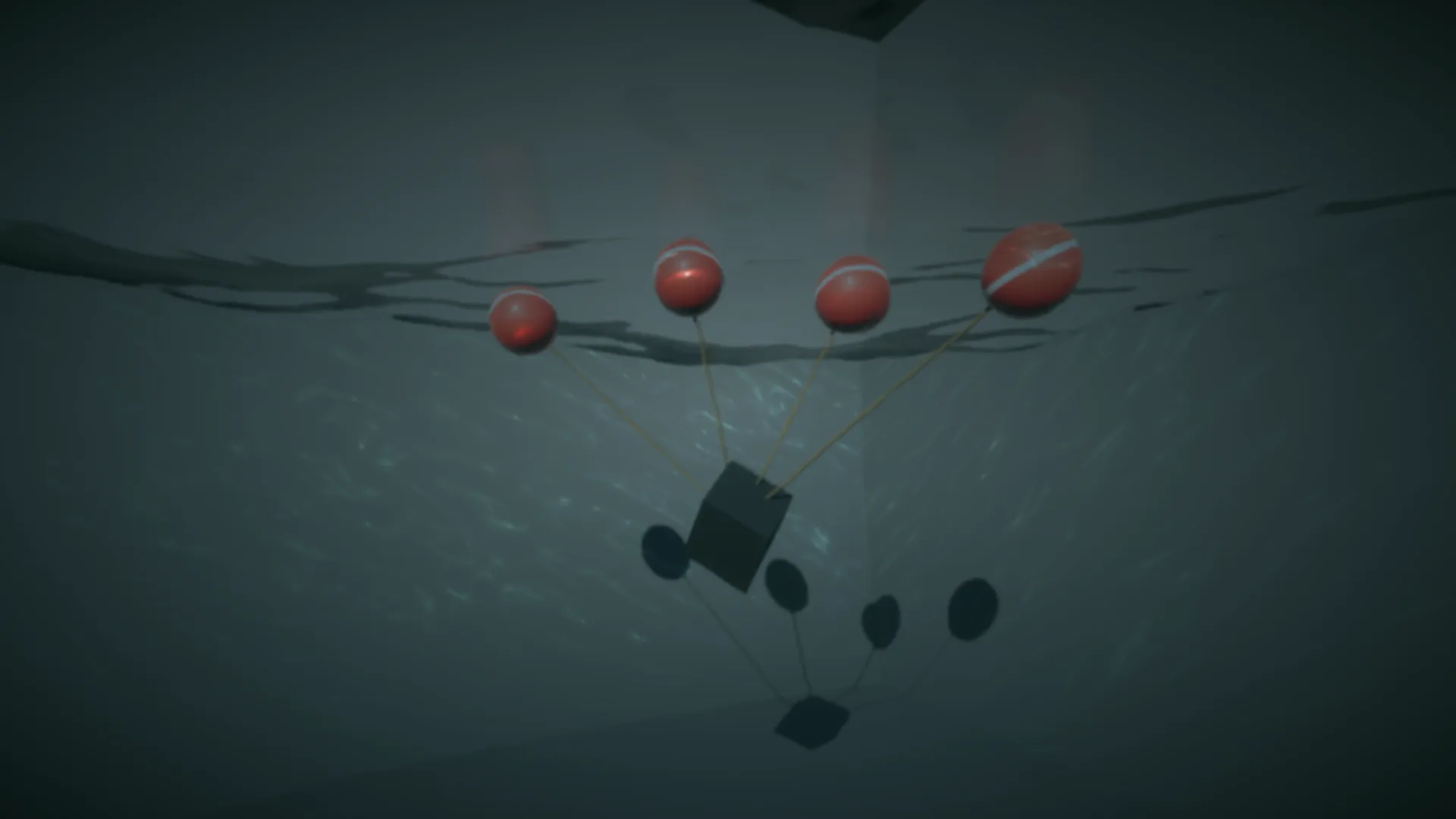
BP_FloatCubeTest/BP_FloatSphereTest(inContent/Blueprints/BuoyantActors/) are minimal targets for sanity-checking water density and damping settings before applying to a complex vessel.
Common pitfalls
Section titled “Common pitfalls”Reference vessels
Section titled “Reference vessels”Study these to learn the patterns:
BP_Runabout(Content/Blueprints/Pawn/Vessels/Runabout/): planing powerboat. Hull shapes + engine + rudder + propulsion data. Good general reference.BP_Dinghy(.../Dinghy/): small displacement boat. Minimal shape layout.BP_TallShipdata assets (.../TallShip/): large vessel with sails (multiplePropulsionDataAssetinstances) and keel as a separate ControlSurface.BP_FloatCube/BP_FloatSphere/BP_MultiBuoyFlotationRig(Content/Blueprints/BuoyantActors/): minimal test objects.